Out first decision after leaving León (other than where to stop for coffee) was whether or not to take the alternative southern route at a split in the way.
The benefits? It ran through more countryside and less along the roadside, and was slightly shorter (by 3.2km – around 45m walking time). The drawbacks? It had less shade and access to water points.
We chose the alternative route, as we had enough water between us to last us to our evening destination halfway along the split (Villar de Mazarife, around 21.5km from León).
As promised in my previous update, we were staying at a hostel that served vegetarian food, and it was absolutely delicious. The starter was a courgette soup, and the main was a vegetable paella, with some lovely charring on the rice and vegetables.
The next day saw us arrive at the end of the split, in Hospital de Órbigo – a very picturesque town with mediæval features (we’ve nicknamed it the “jousting stick town” 😀). It has an amazing stone bridge and jousting arena, and occasionally holds jousting competitions!
While waiting for our hostel to open, we made another field lunch using the morcilla curado we sourced in León (cured black pudding, ready to eat), on some lovely fresh bread from the local tienda.
Leaving Hospital de Órbigo the next day wasn’t hard work, but there were no options for coffee. In fact, the first place was around 5km in – at a hillside donativo just before Santibañez de Valdeiglesias – using a stovetop moka pot.
Around 6km or so later – quite literally in the middle of nowhere, we knew there was another amazing donativo providing tea, coffee, juices, biscuits… and entertainment in the form of a dog that loved to play football!
Unlike our 2024 trip, we decided to stay in Astorga. This decision was – perhaps unsurprisingly – swayed by our foodie choices 😀. There’s a local delicacy called cocido maragato, a lovely – and very meat-heavy – stew served in reverse (you start with the meat course, then have the vegetable course, then have the soup course).
The dish originates in a small village just south of Astorga called Castrillo de los Polvazares (around a 10-minute taxi ride – the first time we’d set foot in a vehicle on this trip!), and we found a Michelin-recommended restaurant called Casa Coscolo who gave us their fantastic twist on it.
The meat course consisted of home-made morcilla, chorizo, smoked fat, pigs’ ears, trotter, pork jowl, shin of beef (possibly ox), and two types of dumpling (chicken and we think a white sausage meat) – and not a small amount of any of these 🤤. It was served in a pig-shaped tureen, and came with a lovely wine and copious amounts of bread (as is the Spanish way). It was lip-smackingly sticky, with lots of well-cooked gelatinous goodness 🤤 🤤 🤤.
We almost didn’t need the vegetable course or the soup course, although we still powered through them anyway, and we just about had room for the amazing set-custard-like dessert 😅. Thankfully, the chef had made some home-brew digestivo to help cut through the richness of the food – made from orujo, grappa, cinnamon, coffee, and likely a few secret ingredients. The best part? When we finished one bottle, another turned up. And then another 😂.
Bearing in mind that this was a lunchtime feast, we didn’t need to eat at all for the rest of the day 😂.
After leaving Astorga the next morning, we knew we were in for a rough time – a 26.5km climb uphill, with the last few hours being steep and rocky in the hot Spanish sun. Still, we made it to our destination of Foncebadón and found our hostel for the evening.
This morning we knew we had a short day, but that was by design as the downhill section was even more of a killer than yesterday’s uphill section. Steep, with many razor-sharp rocks sticking up vertically, it had a lot of injury potential – and so we decided to call it a day in El Acebo at a lovely hotel with pool (but also rooms for pilgrims).
On the way from Foncebadón to El Acebo lies the Cruz de Ferro (iron cross). Widely known as the highest point on the Camino Francés, it’s a point that many people choose to leave a stone, rock, or other token to unburden themselves.
The romantic-, spiritual-, emotional baggage-dumping-, trinket-dumping-, or just fun-potential of the cross aside, it’s often touted as the as the highest point on the Camino Francés. However, just as we did in 2024, we’ve disproven that quite easily again this trip.
It’s stated to be at 1498m or 1500m altitude, and yet an hour or so later after Manjarín, there’s a spot that measures around 1510m altitude. I don’t need to repeat the technical details or location from my 2024 post, but – needless to say – the point still stands that anyone who claims Cruz de Ferro is the highest point on the Camino Francés is probably wrong. Unless GPS devices are lying… and that’s unlikely 😁.
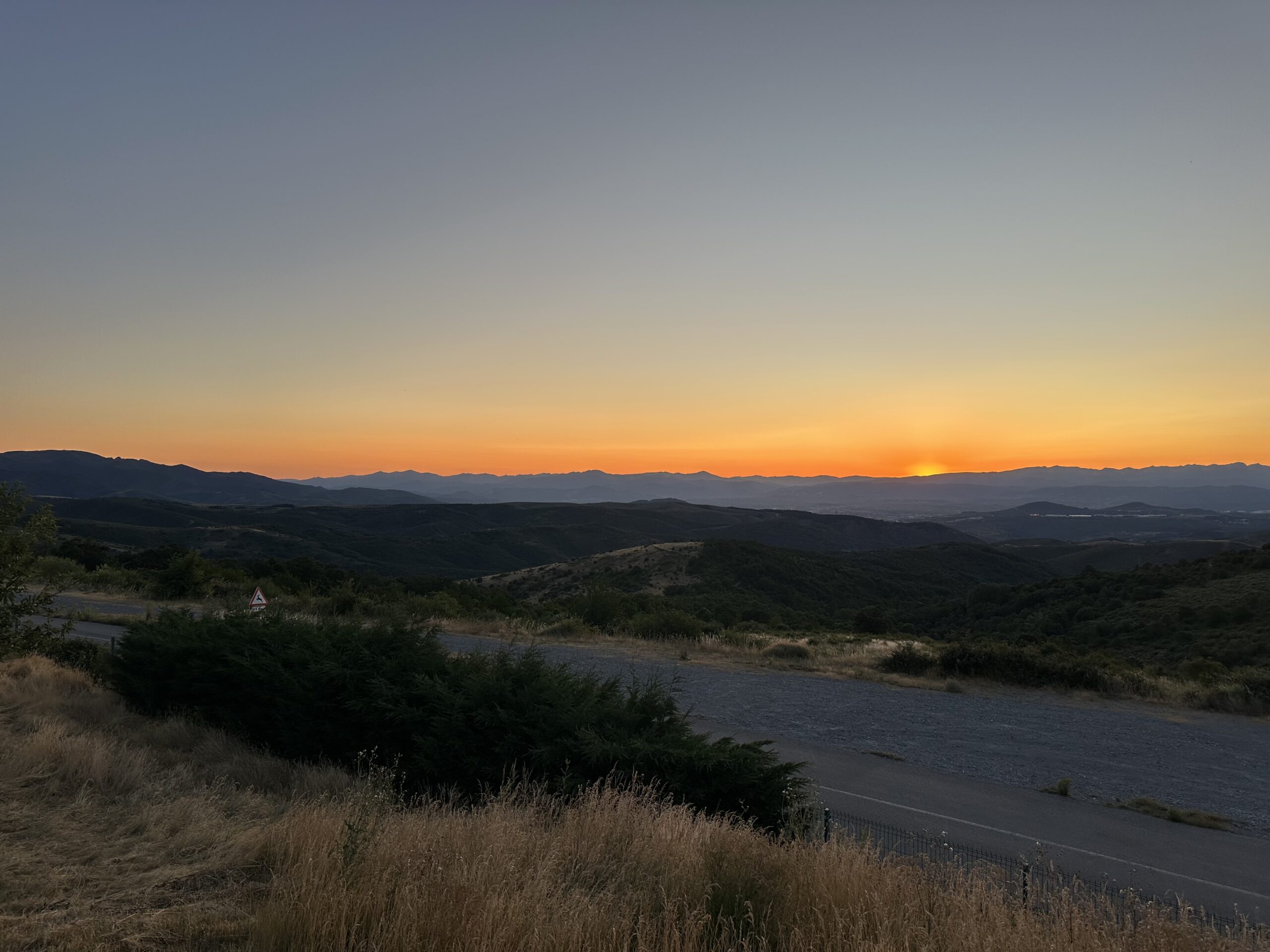
Tomorrow we continue our steep downhill journey to Ponferrada, but not before watching an epic sunset behind the mountain range in the distance – one we’ll be traversing soon when heading into Galicia!